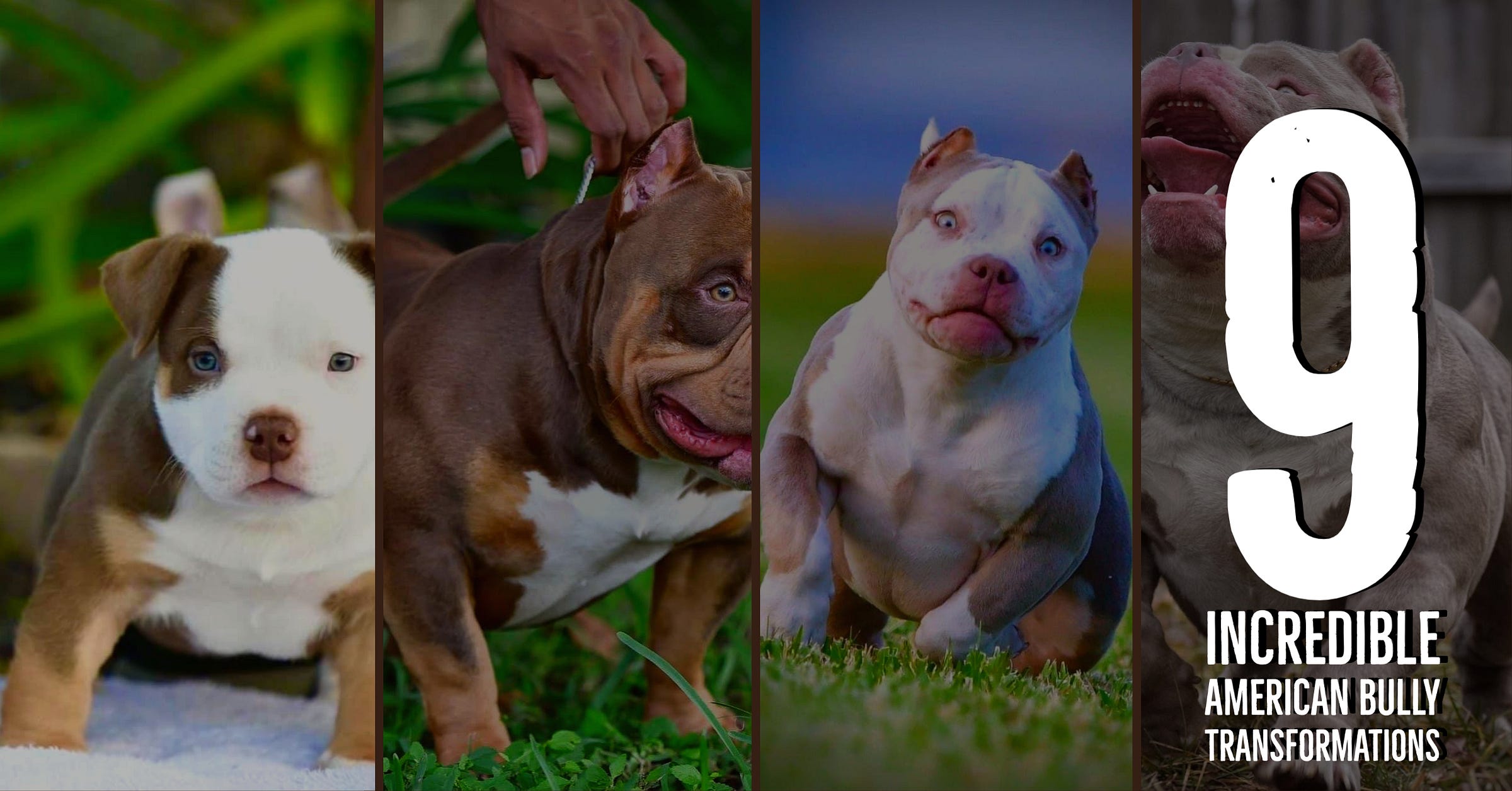
9 Incredible American Bully Transformations You Have to See To Believe!
9 Incredible American Bully Transformations You Have to See To Believe (Pups to Adults)
Puppies are easy to sell. Adult outcomes are what separate a serious program from the crowd. This 2026 visual + educational guide breaks down American Bully puppy-to-adult transformations, how to read what you’re seeing (structure, head development, bone, movement, temperament), and how to use adult production proof to pick the right breeder, bloodline, and litter.
What you’ll learn in this guide
- Why “pups to adults” proof matters more than puppy photos
- What changes are normal (and what’s a red flag) from 8 weeks to 24 months
- How to judge productions like a breeder: front, rear, topline, feet, head, movement
- How genetics + conditioning shape the final dog (without myths)
- How Venomline builds consistency across litters with proven studs and females
(Informational only — always consult a qualified veterinarian for health concerns.)
Fast paths (buyers & breeders)
Top Stud Louis V Line’s Venom — known worldwide for consistent type and production proof.
Table of Contents
- Why Puppy-to-Adult Transformations Matter (2026 Buyer Reality Check)
- The 8–24 Month Timeline: What Changes, When, and Why
- How to Judge Transformations Like a Breeder (Structure Checklist)
- The #1 Mistake Buyers Make: Falling in Love with a Puppy Photo
- What “Proven Production” Actually Means (And How to Verify It)
- Genetics vs Conditioning: What’s Real, What’s Hype
- 9 Incredible Transformations (Pups to Adults)
- Recent Venomline Litters + Customer Litters: What Consistency Looks Like
- Venomline Studs & Bloodline Proof (Why These Pairings Hit)
- People Also Ask (Snippet-Ready)
- Frequently Asked Questions (10)
- Helpful Links
- About the Author – Venomline Elite Team
- Legal & Health Disclaimer
Why Puppy-to-Adult Transformations Matter (2026 Buyer Reality Check)
If you’ve ever searched “american bully transformations” or “pups to adults”, you already know the truth: puppies don’t stay puppies. And in the American Bully world, that single fact is the difference between buying a future show-quality companion… or paying premium money for a dog that matures into something completely different than expected.
In 2026, the marketplace is louder than ever. Social media makes it easy to post a flattering angle, a tight crop, or a “stacked” puppy picture that looks unreal. But a photo can’t tell you: how a dog will carry itself at 18 months, how the front assembly will hold under muscle, whether the rear stays functional, or if the head will finish clean and proportionate to the frame.
That’s why transformation proof is one of the most valuable forms of breeder transparency. When a program consistently shows puppy-to-adult progressions, you’re seeing evidence of: genetics that reproduce, a development plan that protects structure, and a selection process that doesn’t rely on hype.
The simple rule Venomline teaches buyers
Don’t buy the puppy. Buy the adult your puppy is most likely to become — based on adult productions, consistent type, and verified proof.
To make this practical, this guide does two things: (1) it shows you transformation examples so you can visualize what’s possible, and (2) it teaches you how to judge what you’re seeing — so you can use transformation content as a buyer protection tool, not just entertainment.
The hidden reason transformations matter more in Bullies than many breeds
Many dog breeds mature with fairly predictable changes. American Bullies are different because: the breed has broad variation in size classes, head types, bone, and maturity rate. Some lines “pop” early and plateau. Others look modest at 10–14 weeks and transform drastically between 8–18 months. Without adult references, buyers can misread a puppy entirely.
In other words: two puppies can look similar at 8–10 weeks. One becomes a compact, balanced adult with a clean front and powerful rear. The other matures into a heavy, unstable build with compromised movement. Same age. Similar puppy photos. Completely different adult reality.
“What do they look like now, as adults?”
That question is not “extra.” It’s the smartest question a buyer can ask — because it forces a breeder to demonstrate results rather than promise them.
What transformations reveal that pedigrees alone can’t
Pedigrees matter. But pedigree names don’t guarantee your puppy will mature into the structure and temperament you want. Transformations reveal real-world outcomes — and they expose the difference between: a dog that photographs well for a moment and a dog that holds quality through maturity.
- Front stability: Does the dog keep clean shoulders, solid pasterns, and stable elbows as mass increases?
- Rear drive: Does the rear stay powerful and functional, or does the dog lose drive as it fills out?
- Topline consistency: Does the dog maintain a strong back and balanced proportions at adult weight?
- Head development: Does head growth match the frame, or does it become exaggerated and unbalanced?
- Temperament maturity: Does confidence develop, and does the dog stay stable in real environments?
The goal is not just “big.” It’s balanced, functional, correct, and consistent. That’s what separates true programs from pages full of one-time viral puppy pictures.
The 8–24 Month Timeline: What Changes, When, and Why
Most buyers expect a straight line: puppy → bigger puppy → adult. American Bullies usually don’t develop that cleanly. Their growth is more like phases — and understanding those phases makes transformations make sense.
Phase 1: 8–16 weeks — “Puppy type” dominates
At this stage, many puppies look rounder, softer, and less “finished.” Heads can appear smaller relative to bodies (even in lines that will later throw massive adult heads). Bone may look present but not fully expressed. Fronts are still developing, and rears are not yet built out. This is where buyers get tricked: they expect a puppy to look like a mini adult.
Smart evaluation at this stage focuses on foundational markers: feet, pastern strength, shoulder placement, topline stability, bite/airway comfort, and overall symmetry. The puppy doesn’t need to look “finished.” It needs to be built on a frame that can mature into something correct.
Phase 2: 4–8 months — the “awkward athlete” stage
This is where a lot of Bully puppies go through awkward periods — they can look leggy, slightly narrow, or temporarily out of proportion. Buyers who don’t understand this stage panic and assume something is “wrong.” It’s usually not. It’s part of development.
Heads begin to widen. Cheeks may start to develop. Chest begins to broaden. But the most important thing during this stage is protecting structure: overfeeding, too much pounding exercise, and “dirty bulking” can permanently ruin what genetics could have delivered.
Phase 3: 8–14 months — the frame locks in, muscle starts to show
This is when you start seeing real transformation. The dog’s proportions start to stabilize. Chest drops. The rear becomes more powerful. The dog carries itself differently. If the program is consistent, you also start seeing the “type” show up across relatives — this is where transformation proof becomes insanely valuable for buyers.
Phase 4: 14–24 months — adult finish (head, chest, depth, confidence)
Many Bullies “finish” later than people expect. Heads can keep developing through 18–24 months, especially in thicker lines. Chest depth and rib spring can improve. Muscle maturity becomes obvious. Temperament also matures — many dogs become calmer, steadier, more confident.
2026 realism: not every dog “finishes” the same
Genetics drives maturity speed. So do nutrition, conditioning, stress, and environment. That’s why the best predictor is still the same: adult productions from the same program and bloodline.
How to Judge Transformations Like a Breeder (Structure Checklist)
Watching a transformation is fun. But the real advantage is being able to judge it. If you can assess a puppy-to-adult progression the way experienced breeders do, you protect yourself from marketing tricks and start making evidence-based decisions.
1) Front assembly: the place where many “big” dogs fail
In the Bully world, it’s easy to produce a dog with size and head. What’s harder is maintaining a clean, functional front as the dog matures and fills out. When you review transformations, look at:
- Shoulder placement: does the shoulder sit clean, or does it look loaded and forward?
- Elbow stability: do elbows stay tight, or do they wing out as weight increases?
- Pastern strength: do pasterns stay strong and upright, or collapse under mass?
- Feet: are feet tight and balanced, or flat/spread (a common red flag as dogs get heavier)?
A mature dog with a strong front can move comfortably and stay athletic. A dog with a compromised front might look impressive standing still, but breaks down over time. That’s why adult proof is everything: it exposes whether a line holds up when fully developed.
2) Topline and balance: “wow” shouldn’t come from imbalance
A powerful Bully should still look proportionate. In transformations, pay attention to whether the topline stays stable and whether the dog remains balanced from head to rear. A dog can gain mass and still stay clean — that’s the goal.
- Back strength: does the back stay firm or dip/roach as the dog matures?
- Proportion: does the head match the frame, or does it overwhelm it?
- Neck/shoulder flow: does the dog look connected and athletic, or stiff and jammed?
3) Rear: the engine of movement and athleticism
A thick dog with a weak rear is not a win. In transformations, look for rear strength and drive. A good rear should look powerful but still functional — the dog should be able to run, play, and move confidently. Watch for:
- Rear angulation: balanced and supportive, not straight and restricted.
- Hock stability: hocks shouldn’t wobble as the dog moves or stands.
- Thigh/hamstring development: the rear should fill in as maturity hits.
4) Head development: shape > size
Head growth is one of the most dramatic transformation markers in Bullies. But bigger isn’t automatically better. What you want is a head that finishes with: width, shape, clean cheeks, and proportion to the body. If a puppy head looks “small” at 10 weeks, that’s not a problem — if the line is known to finish. Adult proofs show whether the head “comes in” properly.
5) Temperament maturity: the quiet transformation nobody posts enough
The best transformations aren’t only physical. They’re behavioral. A stable adult Bully should be confident, calm, and social — especially around families. Puppies are naturally playful. Adult temperament is where breeding decisions show up.
The #1 Mistake Buyers Make: Falling in Love with a Puppy Photo
Let’s be direct: the most common way people get burned is not because they didn’t “research the breed.” It’s because they researched the breed… then made a decision based on a single puppy photo or short video clip.
In 2026, sellers can make almost any puppy look elite in a single image: wide angle lens, low camera angle, tight crop, perfect light, and a short stance that hides faults. That’s not “evil.” It’s marketing. But you can’t build a decade-long companion decision on marketing.
What a puppy photo cannot guarantee
- Adult structure: fronts and rears can change dramatically as weight/muscle increase.
- Movement: still photos don’t show gait, endurance, or comfort.
- Breathing comfort: short muzzles can look good but must remain functional.
- Stability: feet/pasterns that look okay at 10 weeks may collapse at 16 months if genetics or management are wrong.
- Temperament: puppy friendliness is not the same as adult confidence and stability.
The Venomline “proof stack” (what we recommend you demand)
- Adult productions: multiple offspring grown out
- Video proof: natural-light movement clips
- Pedigree transparency: verifiable lineage
- Consistency: not one outlier dog — repeatable outcomes
- Health transparency: breeder can explain testing and care protocols
If a breeder can’t show adult outcomes, you’re taking a bigger gamble — regardless of how good the puppy looks today. Transformations remove the guesswork. They show you the end.
Continue to Part 2 for the deep section that most competitors miss: how to verify “proven production” (without getting tricked), how genetics and conditioning really interact, and the full transformation breakdown + litters + studs proof.
Why American Bully Transformations Matter in 2026
In 2026, “American Bully transformations” and “puppy to adult” content is no longer just entertainment—it’s one of the smartest ways to verify a breeder and protect your investment. Every breeder can post cute puppy photos. That’s the easy part. The difference between an average kennel and a top-tier program is whether the puppies mature into balanced, functional, correct adults with the bone, head, chest, structure, temperament, and overall “type” the breeder promised.
Venomline Truth:
Adult photos and videos reveal what puppy pictures cannot: front assembly, topline stability, rear angulation, movement, conditioning, and the real long-term result of genetics + development. If you’re buying a Pocket or Micro Bully, this matters even more because compact frames demand even tighter quality control.
When you study transformations the right way, you stop shopping emotionally—and start shopping intelligently. You learn to spot the difference between:
- A puppy that is “cute” vs. a puppy with adult potential
- A dog that looks thick in photos vs. a dog that is structurally correct
- A breeder with one viral dog vs. a breeder with consistent productions
- Temporary puppy features vs. genetic structure that holds up at maturity
That’s why we publish transformations—because transparency wins. If you’re doing your homework, you should be looking for exactly what you’re seeing in this article: real pups, real adult outcomes, and a program that can demonstrate it across time.
What Actually Changes From Puppy to Adult (And What Should Not)
Most people judge a Bully puppy like they judge a puppy of any other breed: “big head,” “short legs,” “thick body.” But Bullies change dramatically between 8 weeks and adulthood, and not all changes are positive. Some changes are normal maturation. Others are red flags.
The Bully Growth Timeline: What to Expect by Age
This is a simplified, real-world timeline that matches what most serious Bully programs observe. Individual dogs vary, but the pattern stays consistent.
8–12 Weeks: “Puppy Type” Stage
- Heads look oversized because the body is still immature.
- Fronts look wider due to puppy stance and early rib development.
- Movement can look clumsy—coordination is still developing.
- What matters most: bone, feet, pastern strength, and early proportions.
4–6 Months: “Leggy / Awkward” Stage
- Many pups go through a leggy phase where the body hasn’t caught up.
- Chest begins to deepen, shoulders start to set.
- Teething and appetite swings are common.
- What matters most: topline stability, fronts not collapsing, and feet staying tight.
7–12 Months: “Frame Locks In” Stage
- Structure becomes clearer: front, rear, topline, and proportions.
- Head begins to broaden; cheeks and muzzle balance reveal themselves.
- Conditioning makes a big difference here (lean muscle vs. puppy fat).
- What matters most: functional angles + healthy breathing + stable temperament.
12–24 Months: “Adult Type” Stage
- Dogs fill out: chest mass, shoulder thickness, rear development.
- Head size and shape finalize; neck and back thickness mature.
- Well-bred Bullies gain density without becoming sloppy.
- What matters most: adult correctness—what the dog looks like at true maturity.
What Should NOT Change (Red Flags Buyers Miss)
Transformation content is valuable because it exposes problems that puppy photos hide. Here are “should-not-change” warning signs:
- Feet collapsing (flat feet / splayed toes) as the pup gains weight
- Pasterns breaking down (fronts that soften and drop)
- Front assembly failing (elbows winging, toes turning out severely)
- Topline becoming unstable (roach back, sway back, weak coupling)
- Rear becoming overly straight or excessively cow-hocked
- Breathing discomfort that worsens as the dog matures
- Temperament issues that were “excused” when the dog was little
If a breeder cannot show adult outcomes of the exact bloodline, the exact sire, or the same production style—then you’re gambling. Transformations reduce gamble. They increase certainty.
How to Evaluate an American Bully Transformation Like a Pro
Most “transformation” posts online are just image dumps. That’s not enough to outrank in 2026. To win, we teach you how to evaluate the transformation using a simple, repeatable system—so you can compare any dog from any kennel and immediately see who is producing real quality.
The Venomline 5-Point Adult Outcome Check
Use this checklist every time you look at a puppy-to-adult comparison. If a dog passes all five categories, you’re looking at a true production-quality adult.
1) Frame & Proportion
Does the adult look balanced—head, neck, body, legs, and rear all matching? Or does the dog look like parts were “bolted on” without harmony?
- Compact without being cramped
- Substance without sloppiness
- Legs strong enough to support the mass
2) Front Assembly
Fronts are where “Instagram Bullies” get exposed. The front should be wide, but also functional and stable.
- Elbows close, not flared
- Pasterns strong, feet tight
- Chest broad without collapsing structure
3) Topline & Coupling
A strong topline is a signature of a complete Bully. Weak coupling and poor toplines show up clearly at maturity.
- Back strong and stable
- No dramatic roach or sway
- Rear supports the frame correctly
4) Rear & Movement Potential
Even if you’re not buying a show dog, movement matters. Dogs should be able to run and play without failing mechanically.
- Rear angulation appropriate
- Hocks stable, not collapsing
- Powerful, functional stance
5) Temperament & Presence
A true Bully should be confident and stable. Fearful, unstable, or sharp dogs don’t represent the breed correctly.
- Confident posture
- Stable around people
- Solid nerve and trainability
Photo + Video Proof Standards (What to Ask Any Breeder)
If you want to avoid being misled by angles, lighting, or selective posting, ask for these proof points. Serious breeders can provide them quickly because they already document their program.
- Multiple angles of the adult (front, side stack, rear, moving)
- Natural light video (not just edited reels)
- Adult siblings or related dogs from the same sire/dam line
- Client litter updates showing outcomes outside the kennel
- Pedigree transparency (public pedigree links when available)
If the kennel has a “produced” page, client litters page, and adult updates across multiple years, you’re typically dealing with a program that cares about outcomes—not just deposits. (See: Produced and Client Litters.)
Purchasing an American Bully Puppy in 2026 (How to Avoid Regret)
In 2026, the American Bully market is bigger, noisier, and more aggressive than ever. That means buyers must be sharper. The most common mistake is falling for the puppy photo and ignoring the adult outcome. The second most common mistake is ignoring the breeder’s proof system.
You’re Not Just Buying a Puppy—You’re Buying 3 Things
- Genetics: the ceiling (structure, head type, bone, temperament potential)
- Development plan: how the pup is raised and transitioned (nutrition, stress, early handling)
- Breeder integrity: whether the breeder stands behind the dog long-term
Transformation content helps you evaluate all three at once.
The Breeder Proof Stack (What Real Programs Provide)
When you’re comparing kennels, look for a stacked proof system. The strongest programs typically have:
- Adult productions of the stud (not just one or two)
- Multiple litters documented across time
- Client outcomes (dogs raised elsewhere still look correct)
- Health testing transparency (DNA, panels, or documented protocols)
- Clear process for stud service and puppy placement
At Venomline, we’ve built our reputation on exactly that. If you’re researching our program, use these pages as your verification path:
9 Incredible American Bully Transformations (Puppies to Adults)
Below is a transformation showcase built the way it should be built in 2026: not just “before and after,” but what to notice and why it matters. This is the fastest way to train your eye and understand what separates elite programs from the pack.
As you scroll, compare each puppy photo to the adult outcome and check the Venomline 5-point list: frame, front, topline, rear, temperament/presence.
Transformation #1: Puppy Type → Adult Presence
In early puppyhood, the head often looks exaggerated relative to the body. What matters is whether the adult keeps the balance and develops into a strong, correct frame instead of turning into a “front-heavy” dog with structural compromise.
What to notice: clean front stance, tight feet, stable backline, and adult muscle density without sloppy conditioning.
Transformation #2: Compact Build → Mature Structure
A true compact Bully doesn’t mature into a cramped, dysfunctional adult. The best adults stay short and thick while maintaining function. This is where weak programs fail and strong programs shine.
What to notice: shoulder set, elbow stability, and rear support under mass.
Transformation #3: Bone & Feet Tell the Future
Feet and pasterns are the first place “fake thickness” gets exposed. A puppy can be wide and thick, but if feet are flat and pasterns are soft, that frame often breaks down with size. Great transformations keep tight feet and strong support.
What to notice: toe tightness, pastern angle, and whether the dog stands confidently without wobble.
Transformation #4: Head Development (Not Just “Big”)
In 2026, everybody sells “big head” dogs. But a big head isn’t the goal—head shape, proportion, and muzzle balance matter more. The best adults carry a strong head without sacrificing breathing comfort or overall balance.
What to notice: cheek development, muzzle proportion, underjaw, and adult expression.
Transformation #5: Chest Width vs. Front Correctness
Chest width is a Bully signature. But “wide” without correct assembly becomes unstable. Elite transformations show that the dog matured into a broad chest with stable elbows and correct stance.
What to notice: elbows not winging, toes not severely turning out, and a confident front posture.
Transformation #6: Athletic Function (Yes, Even for Extreme Builds)
Even the most extreme-looking Pocket or Micro Bully should still be able to run, play, and live comfortably. When you see adult outcomes that remain athletic and functional, you’re seeing a program that didn’t chase “looks” at the expense of the dog.
What to notice: balanced rear, stable back, and a body that looks powerful rather than strained.
Transformation #7: Temperament Shows in the Adult
Temperament gets clearer as dogs mature. A stable adult is confident, composed, and people-friendly. A nervous adult can be “managed,” but it’s not what most families want—and it’s not what serious programs aim to produce.
What to notice: calm posture, confident stance, and stable expression in adult photos/videos.
Transformation #8: The “Consistency Test”
One transformation can be luck. Multiple transformations across the same program prove consistency. This is why we document across time and why buyers should demand the same from any breeder they’re considering.
What to notice: similar type, bone, head style, and structure across different dogs and litters.
Transformation #9: Proof of Production
The highest-level transformation proof isn’t just “our kennel dog.” It’s client litter outcomes, dogs raised in different homes, on different routines, still maturing into the same Venomline type. That is what separates a brand from a program.
What to notice: adult outcomes outside the kennel—this is the strongest proof buyers can get.
Why Venomline Transformations Look Different
Most kennels can produce one nice dog. The real question is whether they can do it repeatedly—across litters, across years, and across different blood combinations—without losing the signature type.
Venomline’s program focuses on five pillars that show up clearly in adult transformations:
- Proven sires with documented productions (not just “popular” names)
- Females that match the mission (structure + type + consistency)
- Selection pressure (we keep what performs, not what just sells)
- Balanced development (nutrition + growth control + conditioning)
- Transparency (we show outcomes, not just promises)
Want to verify outcomes fast?
- Start with Produced (adult results)
- Then check Client Litters (outside outcomes)
- Then compare against Studs (the genetic foundation)
Recent Venomline Litters (Highlights + What They Teach You)
This section is designed to answer high-intent searches like: “Venomline litters,” “Venomline puppies,” “Pocket Bully litters,” and “best American Bully breeder near me.” It’s also here to show the difference between “marketing” and real program documentation.
Venom × Cartier
Matchup: Venom meets Beijing Boy influence—built for type, head, and adult presence.
Why it matters: Outcross-style pairings test whether a program’s foundation traits hold up when you introduce different blood. Strong programs stay consistent.
Video reference: https://youtu.be/dzUVUgd1OEE
Venom × Xena
Matchup: A strategic pairing using linebreeding principles to consolidate traits—done carefully, not recklessly.
Why it matters: When done correctly, this approach increases predictability in adult outcomes (structure, head type, bone, temperament). When done poorly, it magnifies weaknesses. Adult transformations are how you confirm it was done correctly.
Video reference: https://youtu.be/NW4M-_3xUz8
Savage × Storm
Theme: Dense bone, compact frames, and head shape consistency.
Why it matters: The extreme look is easy to chase; the hard part is keeping correctness and function. Mature outcomes show whether the dogs remain balanced as adults.
Video reference: https://youtu.be/pqMg2pss7-A
Recent Customer Litters (The Strongest Proof in the Game)
When your studs produce elite dogs in someone else’s yard, under someone else’s feeding plan, and still mature into the same type—your stud is the real deal. This is why customer litters matter so much, and why they’re the strongest proof for a buyer.
Customer Litter #1: King V × Fendi
Produced by: Bullistic Label Bullies (using Venomline’s King V)
What this proves: The stud’s consistency beyond the home program. This is how you validate real production value—not just “our best puppy.”
Customer Litter #2: King V × Dallas Marie
Produced by: Rigg Tuff Bullies
What this proves: Different blood, similar adult results. This is exactly what buyers should look for when selecting a stud or a puppy: predictable outcomes, repeatable quality.
If you only look at kennel-owned adults, you’re seeing the “best case.” Client litter outcomes show the “real world.” That’s why we publish both.
Venomline Studs Featured in This Article
Because this article originally started as a transformation showcase, it naturally includes the studs that have had the biggest impact on adult outcomes. In 2026, buyers search by stud name just as often as they search “Pocket Bully puppies.” This section is formatted for that intent.
Louis V Line’s Venom (Legacy Producer)
Venom’s influence is global—because production is what matters. This article exists partly because we’ve documented outcomes long enough to show how pups develop into real adults.
- Status: Closed to public reservations (as stated on the page)
- Stud service: Frozen only (limited units)
- Pedigree: View Pedigree
Production reference (external): View Productions
Venomline’s King V
King V is a core example of why transformations matter—buyers want to see the adult outcomes and how the stud throws type across different females.
- Stud info: Available Studs
- Process: How Stud Service Works
Venomline’s Savage
Savage is featured because the program goal is not just “thick”—it’s thick with correctness. Adult outcomes reveal whether that goal was achieved.
Next Steps: If You’re Serious About Buying, Do This Next
If you’re reading this because you want a Pocket or Micro American Bully and you’re trying to make the smartest decision possible, here’s the exact next-step sequence we recommend in 2026:
- Start with outcomes: browse Produced and Client Litters.
- Confirm availability: check Available Puppies.
- Understand the process: read How Stud Service Works if you’re a breeder or planning a litter.
- Compare responsibly: ask any breeder for adult outcomes, videos, and proof stack. If they can’t provide it, move on.
Fast contact (best method): Text 832.452.0898 for availability, upcoming litters, and stud service inquiries.
For updates, follow Venomline on social: Instagram • Facebook • Pinterest • YouTube • Medium
Voice Search Optimizations (2026)
Say it like you’d ask it:
-
“How do I tell if an American Bully puppy will look good as an adult?”
Look for adult outcomes from the same bloodline, verify front assembly and feet, and compare multiple pups from the program—not just one highlight dog. -
“What age does an American Bully look full grown?”
Most Bullies show adult type between 12–24 months, with mature mass and head development continuing through that window. -
“What should I look for in a Pocket Bully transformation?”
Balance, strong feet/pasterns, stable topline, correct front, and functional rear—plus calm, stable temperament. -
“Why do Bully puppies look different at 6 months?”
They often hit an awkward growth phase where legs and frame change faster than chest and muscle; structure and feet tell the truth during this stage. -
“How can I verify a breeder is legit?”
Ask for adult productions, client litter outcomes, proof stack (photos + videos), and transparent processes for placement and policies.
People Also Ask (PAA) – Snippet-Ready
What are American Bully transformations?
American Bully transformations are before-and-after comparisons showing how a Bully looks as a puppy versus how it matures as an adult. They’re used to evaluate a breeder’s consistency, verify “adult type,” and confirm structure, head style, bone, and overall balance at maturity.
When do American Bullies stop growing?
Most American Bullies reach their mature frame around 12–18 months, but many continue filling out—head, chest, and muscle density—through roughly 18–24 months. True adult presence is often clearest after the 1-year mark.
How can I predict what my American Bully puppy will look like as an adult?
The most reliable method is to study adult outcomes from the same sire, bloodline, and program. Then evaluate your puppy’s feet, pastern strength, shoulder set, topline stability, and overall proportions—those structural traits predict adult function far more than “cute puppy thickness.”
What should a high-quality Pocket Bully look like as an adult?
A high-quality Pocket Bully should look compact yet balanced, with tight feet, strong pasterns, a stable topline, correct front assembly, and a functional rear. The dog should carry muscle and bone without looking strained or mechanically compromised.
Why do some Bully puppies look great but grow up poorly?
Because puppy photos can hide structural weaknesses that show up under adult weight. Common reasons include soft feet/pasterns, weak front assembly, unstable toplines, poor rear support, and breeding for extreme looks without maintaining balance and function.
Why do client litter outcomes matter more than kennel photos?
Client litter outcomes show whether a stud or bloodline produces consistent type outside the breeder’s own yard. If pups raised elsewhere still mature into the same look and structure, that’s stronger proof of genetic consistency than a few hand-picked kennel-owned adults.
What’s the fastest way to verify an American Bully breeder?
Ask for adult productions, multiple-angle photos and natural-light videos, and client litter updates. Then compare those outcomes with the breeder’s “Produced” and “Client Litters” documentation and confirm they have a clear, transparent process for placement and support.
Frequently Asked Questions (10)
-
What age is best to judge an American Bully’s structure?
You can assess early markers (feet, pasterns, shoulder set) as a puppy, but the best structural judgment happens between 12–24 months when the dog has matured and filled out. -
Do Pocket Bullies mature faster than Standards?
They can appear “finished” sooner due to compact frames, but true maturity still takes time—most Pockets continue developing mass and head through 18–24 months. -
Is a bigger head always better?
No—head shape, proportion, and balance matter more than pure size. The goal is a strong, correct head that fits the body and remains functional. -
What’s the #1 red flag in puppy-to-adult transformations?
Structural breakdown: collapsed feet, soft pasterns, unstable toplines, or fronts that fail as the dog gains adult weight. -
How many adult productions should a breeder show before I trust them?
Look for multiple adult outcomes across different litters and ideally client litter results. One nice adult can happen by chance; repeated outcomes indicate a program. -
What photos should I request if I’m serious about buying?
Ask for front, side stack, rear, and moving video in natural light. Also request adult examples from the same sire line and, if possible, client litter updates. -
Can conditioning make a mediocre Bully look elite?
Conditioning can enhance muscle definition, but it can’t fix poor structure. Adult transformations reveal whether the “look” is genetics or marketing. -
What’s the difference between “thick” and “correct”?
“Thick” is mass; “correct” is balanced structure that can support mass—tight feet, stable front, strong topline, functional rear, and sound movement. -
How do I compare two breeders using transformations?
Compare adult outcomes for: (1) front assembly, (2) topline stability, (3) feet/pasterns, (4) overall balance, and (5) consistency across multiple dogs and litters. -
Where can I see more adult outcomes from Venomline?
Start with Produced and Client Litters, then review Studs to connect the outcomes to the foundation genetics.
🔗 Helpful Links
- 🔗 About Venomline
- 🔗 Pocket Bully Puppies for Sale
- 🔗 Venomline Studs
- 🔗 How Stud Service Works
- 🔗 Produced (Adult Outcomes)
- 🔗 Client Litters (Outside Proof)
📚 Further Reading
- The Definitive Pocket Bully Guide
- Best Pocket Bully Breeders USA
- Pocket Bully Health Testing
- American Bully Temperament Guide
- American Bully Puppy Cost & Price Guide
Author Bio
About the Author – Venomline Elite Team
Venomline’s expert team leads this guide—headed by the acclaimed author of The Bully Bible, founder of BULLY KING Magazine and a top-tier breeder. With 10+ years in breeding, training, and advocacy, Venomline has produced 50+ ABKC Champions and 25+ Grand Champions.
As passionate breed advocates, rescue donors, and volunteers, Venomline offers field-tested insights and expert guidance to help you raise a confident, well-trained Bully.
Legal & Health Disclaimer
This guide is for informational purposes and is not a substitute for individualized veterinary care. Always consult your veterinarian before making significant changes to your dog’s diet, supplements, training, or exercise program—especially for puppies, seniors, and dogs with medical conditions.
Last Updated January 15, 2026
Comments
Zane coles
June 01 2022
I’m out in South Africa and I would like to have a pair of this marvelous bloodline in South Africa . How can I make that possible . Please let me know. Thank you
Comments
1 Comment